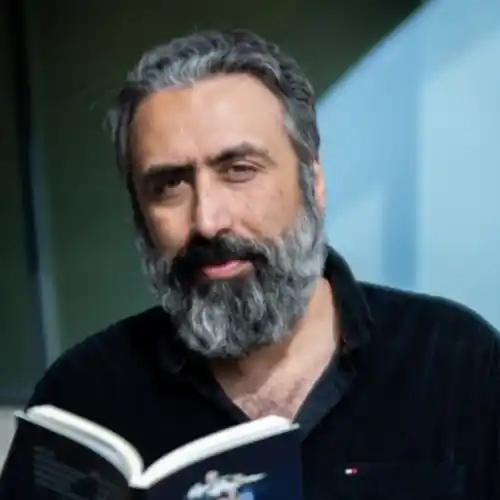
Mehdi Mousavi
Poet · Writer
Mehdi Mousavi is an Iranian poet and writer widely associated with the contemporary development of the literary movement known as Postmodern Ghazal.
His work combines classical Persian poetic traditions with modern political, social, and personal themes, creating poetry that explores repression, violence, exile, intimacy, memory, and everyday life under authoritarian systems.
Over the past two decades, Mousavi has become recognised as one of the significant contemporary voices in modern Persian poetry, particularly among younger generations of readers and writers inside and outside Iran.
His writing and public literary activity eventually led to imprisonment and sentencing in Iran, after which he later escaped the country and continued his work in exile from Norway.
Postmodern Ghazal
Mehdi Mousavi played a central role in the development of Postmodern Ghazal, a contemporary literary movement that reworked the classical Persian ghazal form to engage with modern political and social realities.
The movement sought to preserve the musicality and literary depth of classical Persian poetry while introducing more direct engagement with censorship, violence, sexuality, social repression, and everyday contemporary experience.
Through this work, Mousavi became associated with a generation of writers attempting to expand the boundaries of contemporary Persian literature.
Writing and Themes
Mousavi’s poetry frequently explores the relationship between private life and political power, often focusing on fear, surveillance, repression, displacement, and emotional survival.
Alongside political themes, his work also examines intimacy, longing, memory, humour, and ordinary human relationships, grounding larger social realities in personal lived experience.
His writing moves between lyricism, satire, tenderness, and violence, often combining contemporary language with references to classical Persian literary traditions.
Imprisonment and Exile
In 2013, Mousavi was arrested in Iran alongside fellow writer Fatemeh Ekhtesari in connection with literary activities and public readings.
He was later sentenced to prison and corporal punishment on charges connected to his writing. Following release on bail, he escaped Iran and later continued his literary work from exile.
His experiences of censorship, imprisonment, surveillance, and displacement continue to shape much of his writing and public engagement.
Collaboration with Sic Publishing
Mehdi Mousavi collaborates with Sic Publishing on literary, translation, and public cultural projects connected to freedom of expression, exile, and contemporary Iranian literature.
Sic Publishing released The Last Kiss, a bilingual Persian–English collection bringing together selections of his poetry in translation.
The project reflects a broader shared interest in literature as testimony, translation as cultural bridge-building, and storytelling as a way of preserving lived experience across borders.
Norway
Since arriving in Norway, Mousavi has continued writing, publishing, participating in literary events, and contributing to international conversations around censorship, exile, literature, and freedom of expression.
His work forms part of a wider contemporary discussion about the role of writers and artists working across borders under conditions of repression and displacement.